
Understanding how Delhi's air quality affects your eyes — and what you can do to protect them.
By Dr. Javed H. Farooqui, Lifeline Eye Centre
Almost every week at our clinic in Laxmi Nagar, patients walk in describing the same thing: burning, gritty, watery eyes that feel worse by evening. Once Delhi's Air Quality Index (AQI) climbs into the "poor" or "severe" range during winter months, ophthalmology consultations for eye irritation rise sharply across the city. This isn't a coincidence — the air we breathe has a direct, measurable effect on the surface of our eyes.
As a cornea and cataract specialist in Delhi, I see firsthand how pollution-related eye complaints cluster through the smog season. This article explains the actual mechanism behind the burning sensation, whether pollution can genuinely cause dry eye syndrome, what the research says about AQI and long-term eye health, and practical steps you can take to protect your vision.
Delhi's air during high-pollution periods carries a mix of particulate matter (PM2.5 and PM10), ground-level ozone, nitrogen dioxide, sulfur dioxide, and smoke from vehicle exhaust, construction dust, and crop burning. The surface of the eye — the cornea and conjunctiva — is directly exposed to the environment, unlike most other organs. When these fine particles and gaseous pollutants settle on the tear film, they trigger a cascade of problems:
PM2.5 particles are small enough to disrupt the tear film's protective lipid layer, causing tears to evaporate faster than normal.
Nitrogen dioxide and ozone act as chemical irritants, triggering inflammation of the conjunctiva (the clear membrane covering the white of the eye).
Dust and smoke particles can physically abrade the corneal surface, especially in contact lens wearers whose lenses trap irritants against the eye.
Chronic low-grade inflammation from repeated pollutant exposure can gradually damage the delicate meibomian glands that keep tears stable.
This combination is why the burning sensation often feels worse on high-AQI days, during rush hour commutes, or after time spent outdoors near traffic — the eyes are mounting a protective inflammatory response to airborne irritants.
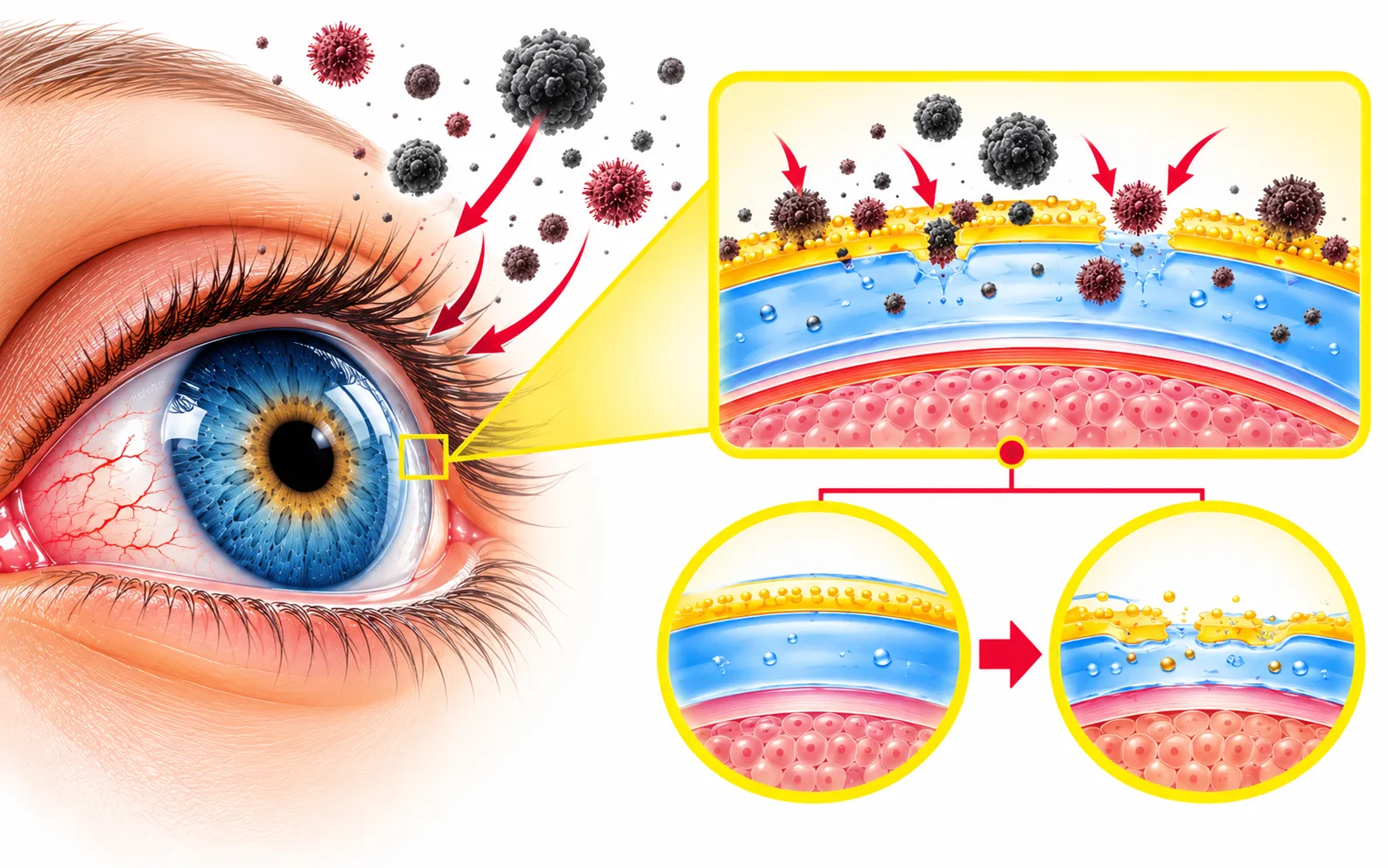
Yes — air pollution is a well-recognised environmental trigger for dry eye disease, even in people who have never had dry eyes before. Dry eye syndrome occurs when tears don't adequately lubricate the eyes, either because tear production is reduced or because tears evaporate too quickly. Pollution contributes to both mechanisms: particulate matter destabilises the tear film's oily outer layer, and chronic exposure can reduce the goblet cells responsible for the mucus layer that helps tears adhere to the eye's surface.
People who already have borderline dry eye — from screen use, contact lenses, ageing, or certain medications — tend to notice their symptoms flare significantly once AQI levels rise. If you already manage dry eye, this is a good time to review your care plan with a cornea specialist rather than relying solely on over-the-counter lubricating drops.
Tip: Use preservative-free lubricating eye drops 3–4 times a day during high-AQI periods, even before symptoms appear — this protects the tear film proactively rather than only treating irritation after it starts.
Beyond the immediate burning and irritation, there is growing clinical interest in how chronic exposure to polluted air may affect eye health over years, not just days. Sustained oxidative stress from airborne pollutants has been associated with accelerated changes to the ocular surface and may contribute to progression of conditions such as cataract and, in some studies, age-related changes to the retina. While pollution alone does not cause cataract, it is considered one of several environmental risk factors — alongside UV exposure, smoking, and diabetes — that can hasten its onset.
This is one reason routine eye examinations matter even if your vision feels stable. Conditions like early cataract or subtle retinal changes often develop without obvious symptoms, and are usually only caught on a dilated eye exam. If you live or work in high-pollution zones of Delhi and haven't had a comprehensive eye check in over a year, it's worth scheduling one — our cataract surgery and evaluation team can assess your baseline lens clarity, and our retina services can screen for any posterior segment changes.
Burning, red, watery eyes during pollution spikes are sometimes mistaken for seasonal allergies, but the two conditions need different management. The table below outlines the key differences we look for during consultation.
| Feature | Pollution-Induced Dry Eye | Allergic Conjunctivitis |
|---|---|---|
| Itching | Mild to moderate | Intense, often the dominant symptom |
| Discharge | Watery, stringy mucus is uncommon | Often stringy, mucoid discharge |
| Onset pattern | Worsens through the day, especially outdoors | Often sudden, triggered by allergen exposure |
| Typical treatment | Lubricants, humidification, tear film support | Antihistamine drops, allergen avoidance |
Most pollution-related irritation settles with simple home care, but certain signs warrant a prompt eye examination rather than self-treatment. If you're unsure whether your symptoms are routine irritation or something more, our guide on when to see a doctor for red eye treatment walks through the warning signs in more detail.
Warning: Seek urgent ophthalmic care if you experience sudden vision changes, severe eye pain, significant light sensitivity, a thick yellow/green discharge, or symptoms that don't improve after a few days of self-care — these can indicate infection or corneal involvement that needs immediate attention.
You can't control the AQI, but you can reduce how much it affects your eyes with a few consistent habits:
Check the local AQI before heading out and limit outdoor time when it's in the "poor" or "severe" range, especially during early morning and evening traffic hours.
Wear wraparound sunglasses outdoors to create a physical barrier against dust and particulate matter.
Use preservative-free lubricating drops regularly rather than waiting for symptoms to appear.
Run an air purifier with a HEPA filter indoors, particularly in bedrooms, since indoor PM2.5 levels can still be high even with windows closed.
Avoid rubbing your eyes — this pushes particulate matter deeper onto the ocular surface and can abrade the cornea.
If you wear contact lenses, switch to glasses on high-pollution days, since lenses trap irritants against the eye surface.
Rinse eyes gently with clean water or saline after prolonged outdoor exposure, such as a commute on a two-wheeler.
If you've considered LASIK surgery to get away from contact lens dependence, pollution exposure is actually a relevant factor to discuss during your evaluation, since corneal healing and post-operative dryness can both be influenced by environmental conditions.
Lifeline has been a recognised name in eye care in East Delhi since 1991, when it was founded by Dr. S.A. Farooqui. Carrying that legacy forward, Lifeline Eye Centre in Laxmi Nagar now offers advanced investigative and surgical solutions for corneal, cataract, retinal, and ocular surface conditions under one roof. I personally bring over 15 years of experience in ophthalmology, including fellowship training in Cornea and Anterior Segment at the Royal Adelaide Hospital, Australia, and in Cornea and Refractive Surgery at Dr. Shroff's Charity Eye Hospital, along with medical retina and laser training at Aravind Eye Hospital, Coimbatore. This focused sub-speciality training in corneal and ocular surface disease is directly relevant to diagnosing and managing pollution-related dry eye and irritation, rather than treating it as a one-size-fits-all complaint.
For families concerned about how pollution affects children's eyes specifically, our pediatric eye specialist guidance covers age-specific precautions, since children's eyes are often more sensitive to environmental irritants than adults'.
If pollution-related burning, redness, or dryness has become a recurring problem rather than an occasional nuisance, it's worth getting your ocular surface properly assessed rather than cycling through different over-the-counter drops. Visit our ophthalmology specialists at Lifeline Eye Centre in Laxmi Nagar for a thorough evaluation, or contact us to book a consultation.