
A practical, stage-wise guide to managing keratoconus — from early collagen cross-linking to corneal rings and transplant surgery — by a fellowship-trained cornea specialist in Delhi.
By Dr. Javed H. Farooqui, Lifeline Eye Centre
Keratoconus is a progressive eye condition in which the normally round, dome-shaped cornea thins and gradually bulges outward into a cone-like shape. Because the cornea is responsible for focusing most of the light entering the eye, this irregular shape causes blurred, distorted vision, increasing nearsightedness and astigmatism, and sensitivity to light and glare. It usually begins in the teenage years or early twenties and can continue to progress into a person's thirties, though the rate of progression varies widely from one patient to another.
At our clinic in Laxmi Nagar, Delhi, we see a steady stream of young patients referred for \"glasses that never seem to work\" — a classic early sign that the irregular corneal curvature of keratoconus, rather than simple refractive error, may be the real culprit. Timely diagnosis is the single biggest factor in preserving long-term vision.
The exact cause of keratoconus is not fully understood, but several factors are known to contribute to its development:
Early keratoconus can be subtle, which is why many patients only seek a cornea specialist in Delhi once vision changes start interfering with daily life. Common symptoms include blurred or distorted vision that is not fully corrected by glasses, frequent changes in eyeglass prescription, increased sensitivity to light and glare, difficulty with night driving, eye strain, and occasional eye rubbing or itching.
Warning: Sudden, severe eye pain accompanied by a rapid drop in vision and corneal clouding can signal acute hydrops, a rare but serious keratoconus complication where fluid enters the cornea through a break in its inner layer. This requires same-day evaluation by an ophthalmologist — do not wait for a routine appointment.
Diagnosis relies on corneal topography or tomography, which maps the curvature and thickness of the cornea in fine detail and can detect keratoconus years before it is visible on a routine refraction. A slit-lamp examination, pachymetry (corneal thickness measurement), and a detailed family and rubbing history round out the work-up. Staging the disease accurately — mild, moderate, or advanced — is what determines which treatment pathway, discussed below, is appropriate for each patient.
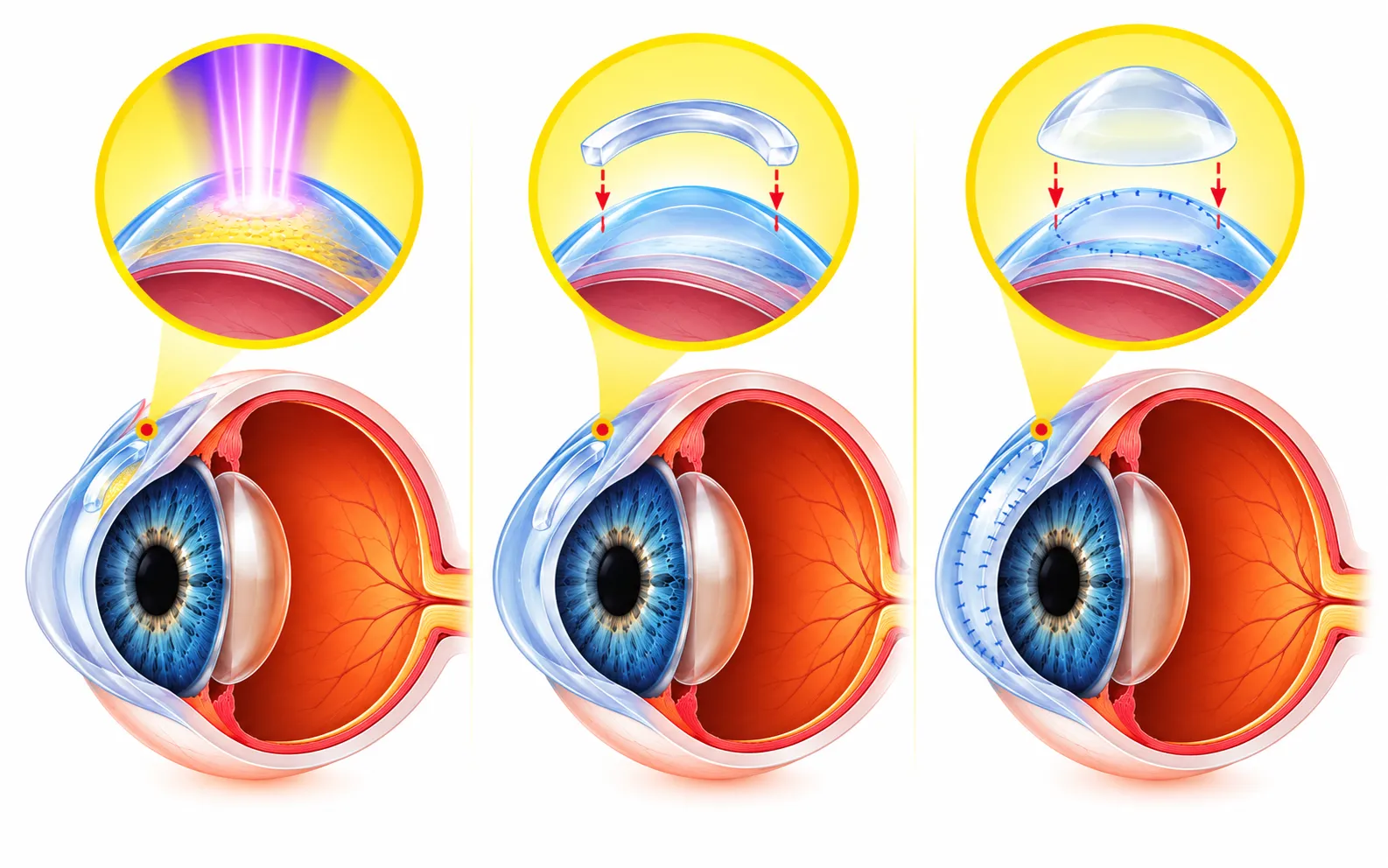
There is no single \"best\" keratoconus treatment — the right option depends on how advanced the condition is at the time of diagnosis. As a cornea specialist with fellowship training from the Royal Adelaide Hospital, Australia and Dr. Shroff's Charity Eye Hospital, I generally guide patients through three broad stages of management.
Cross-linking is the first-line treatment for early to moderate, progressing keratoconus. Riboflavin (vitamin B2) eye drops are applied to the cornea and activated with controlled ultraviolet-A light, creating new chemical bonds between collagen fibres. This stiffens the cornea and, in the vast majority of cases, halts further bulging. CXL does not reverse existing distortion, which is why catching keratoconus early — before significant cone formation — gives patients the best long-term outcome.
For patients with moderate keratoconus who are struggling to achieve usable vision with glasses or contact lenses, small crescent-shaped plastic segments can be implanted within the layers of the cornea. These rings flatten the central cone, reduce irregular astigmatism, and often improve spectacle or contact lens tolerance. ICRS is frequently combined with cross-linking in the same treatment plan to both reshape and stabilise the cornea.
When keratoconus has advanced to the point of significant corneal scarring or thinning that cross-linking and rings can no longer manage, cornea transplant surgery becomes the recommended option. Depending on how deep the damage extends, this may be a Deep Anterior Lamellar Keratoplasty (DALK), which preserves the patient's own innermost corneal layer and carries a lower rejection risk, or a full-thickness Penetrating Keratoplasty (PK) in more severe or scarred corneas. Both procedures replace diseased corneal tissue with healthy donor tissue and have well-established, decades-long track records in restoring functional vision.
| Treatment | Best Suited For | Goal |
|---|---|---|
| Collagen Cross-Linking (CXL) | Early, progressing keratoconus | Stop further corneal bulging |
| Intrastromal Ring Segments (ICRS) | Moderate keratoconus, poor lens tolerance | Flatten cone, improve vision correction |
| Cornea Transplant (DALK/PK) | Advanced, scarred or very thin cornea | Replace diseased tissue, restore vision |
Whichever stage you are at, protecting the cornea from further mechanical stress matters. Avoiding eye rubbing, managing underlying allergies, and wearing UV-protective sunglasses outdoors are simple habits that support whatever treatment plan you are on.
Tip: If you have allergic conjunctivitis and find yourself rubbing your eyes often, treat the allergy aggressively with your doctor's guidance — controlling the itch is one of the few modifiable risk factors in keratoconus progression.
Lifeline Eye Centre has been a trusted name in east Delhi's eye care landscape since Dr. S.A. Farooqui founded Lifeline in 1991. Carrying that medical legacy forward, Dr. Javed H. Farooqui, our senior cornea specialist, trained with Orbis International's Flying Eye Hospital across more than 20 countries before completing a two-year fellowship in complex cataract surgery and an 18-month fellowship in corneal surgery, followed by a further fellowship in Cornea and Anterior Segment at the Royal Adelaide Hospital, Australia. This depth of sub-specialty training means keratoconus patients in Laxmi Nagar and across South Delhi have access to the full treatment ladder — cross-linking, ICRS, and advanced DALK/PK transplant surgery — under one roof, along with related services such as LASIK surgery, cataract surgery, and retina services for patients who need comprehensive, coordinated eye care.
If you notice frequent changes in your glasses prescription, worsening night vision, or a child or teenager in your family who seems to need new spectacles every few months, it is worth getting a corneal topography scan rather than simply updating the lens power again. Early detection is what keeps keratoconus manageable with cross-linking alone, rather than progressing toward surgery. You can schedule a consultation with our team at Lifeline Eye Centre in Laxmi Nagar to get a thorough corneal evaluation.